Wednesday, November 25, 2015

Prime minister Justin Trudeau should call for a worldwide referendum on global carbon fee-and-dividend at the COP21 climate change conference in Paris.
The conference will start on Nov. 30 and will last until Dec. 11.
The general consensus is that, while it will make some progress, it won't make the breakthrough we need.
A worldwide referendum on carbon fee-and-dividend would be that breakthrough.
James Hansen, the man who many consider the dean of climate scientists, has called for carbon fee-and-dividend many years and with some success.
Carbon fee-and-dividend is elegantly simple – charge a fee on fossil fuels at source, similar to a carbon tax. Unlike a typical carbon tax, however, the money would not go into general government revenue but be distributed in equal dividends to everyone.
For those on the right, it's a small government solution. Most governments already collect some kind of tax or royalty from fossil fuel production, and so little additional bureaucracy would be needed to collect the fee. Similarly, people would only need to prove that they are human beings and of a certain age to collect their dividends, meaning minimal bureaucracy on the distribution side as well.
For those on the left, carbon fee-and-dividend would tend to re-distribute income, helping to correct the world’s growing economic inequality. According to Citizens' Climate Lobby – Canada, two-thirds of people would receive more in dividends than they would spend in fossil fuel fees. The bottom 20 per cent of earners could expect to receive 150 per cent more than they would pay.
Many economists agree that carbon fee-and-dividend would be our most powerful tool in dealing with climate change. In fact, it is hard to imagine a successful approach that does not include carbon fee-and-dividend as its central pillar.
Here are some ballpark figures.
According to Wikipedia, the world produces about 30 billion tonnes per year of carbon dioxide through the burning of fossil fuels. A fossil fuel fee set at the same level of B.C.'s carbon tax of $30 per tonne of carbon dioxide would therefore raise about $900 billion per year. Assuming that the dividends would only go to adults, and that 5 billion of the 7 billion people in the world are over the age of 18, then that would mean every adult human being on the planet would get a dividend of about $180 per year.
Carbon fee-and-dividend might be our most powerful tool, but to have a hope of being effective it would need to be global.
National programs, even if they involve major emitters such as the United States or China, are simply not going to cut it.
Put a fee on fossil fuel use in one jurisdiction and certain industries will move to another. If the fee rises high enough, there would be the danger of creating a black market for untaxed oil and coal. Both outcomes could be minimized by global carbon fee-and-dividend.
Going global implies going through the United Nations. Implementing global carbon fee-and-dividend would justify and require reforming that organization. A good place to start might be by creating a United Nations Parliamentary Assembly.
Here in Canada, as in many other nations around the world, we sometimes put important questions to the people in a referendum. One example would be the referendum on transit held last spring in B.C.'s Lower Mainland.
Organizing a worldwide referendum on carbon fee-and-dividend would be a difficult but not impossible task. The United Nations has organized successful votes in war-ravaged locations such as Kampuchea and East Timor.
Human-caused climate change is a global problem and requires global solutions. A worldwide referendum on global carbon fee-and-dividend would be a good next step, and Canada should lead the way.
– Author Keith McNeill is the editor of the award-winning Clearwater Times newspaper. Last spring, McNeill, age 65, and his friend, Jean Nelson, age 81, cycled from Toronto to Ottawa to promote an online petition calling for a Canada-wide referendum on carbon fee-and-dividend.

Tuesday, December 2, 2014

Meeting with the politicians during days three and four of the CCL conference


Participants in Citizen Climate Lobby-Canada's 2014 conference in Ottawa get ready to fan out on Parliament Hill on Monday and Tuesday, Nov. 22 and 23.

Days three and four of the Citizens Climate Lobby-Canada conference were when the rubber hit the road.
After two days of workshops on Nov. 20 and 21, the nearly 70 participants at the conference fanned out across Parliament Hill to speak to 43 MPs and senators to tell them about using carbon fee-and-dividend to control climate change.
Most of them came back optimistic. The general feeling was that there is movement happening behind the scenes in Ottawa on this issue.
This reporter visited three people on the Hill: my own Conservative M.P. for Kamloops-Thompson-Cariboo, Cathy McLeod, New Democrat finance critic Nathan Cullen, the M.P. for Bulkley-Skeena, and Senator Nancy Greene Raine of Kamloops, also a Conservative.
The meeting with Cathy McLeod went well. She is Parliamentary Secretary to the Minister of Labor
CCLers meet with Cathy McLeod, MP.
and Western Diversification. As such, she has a nice office in the Justice Building
with a beautiful view of the Ottawa River.
With me on the visit were Sonia Furstenau and Blaise Salmon of the Cowichan Valley, Geoff Richards of (I believe) Waterloo, Ontario, and Michael Polanyi of Toronto.
McLeod was, perhaps not surprisingly, the perfect hostess – quickly putting everyone at ease.
One got the impression that she was happy to meet with ordinary Canadians to talk about an issue, rather than with professional lobbyists.
Her questions were shrewd and forthright, although one never knew quite what her own thinking might be. She often used phrasing such as, “There are those who say that….” and then asked for a response.
The meeting with Nathan Cullen was not quite so relaxed, possibly because he was expecting to be called away to a vote in the House of Commons.
“Let’s start at the end and work back,” he said, wanting to make sure we covered the meat of the meeting first.
The other CCL members at this meeting were Sonia Furstenau and Blaise Salmon of the Cowichan Valley, Laura Sacks of Nelson, and Nicole Melanson of Saltspring Island.
New Democratic policy is to seek a cap-and-trade approach to climate change control, rather than fee-and-dividend.
Cullen conceded this approach has problems, as the different approaches to cap-and-trade can be complicated, making it too easy to cheat.
The NDP finance critic asked some tough questions about the fee-and-dividend approach. One got the impression, however, that he might have been looking for good answers that he could use if he brought the subject up elsewhere.
This reporter’s final meeting was with Senator Nancy Greene Raine late on the Tuesday morning. She was between meetings in the East Block and, as her office is in another building, we had to meet in the hallway by the security counter.
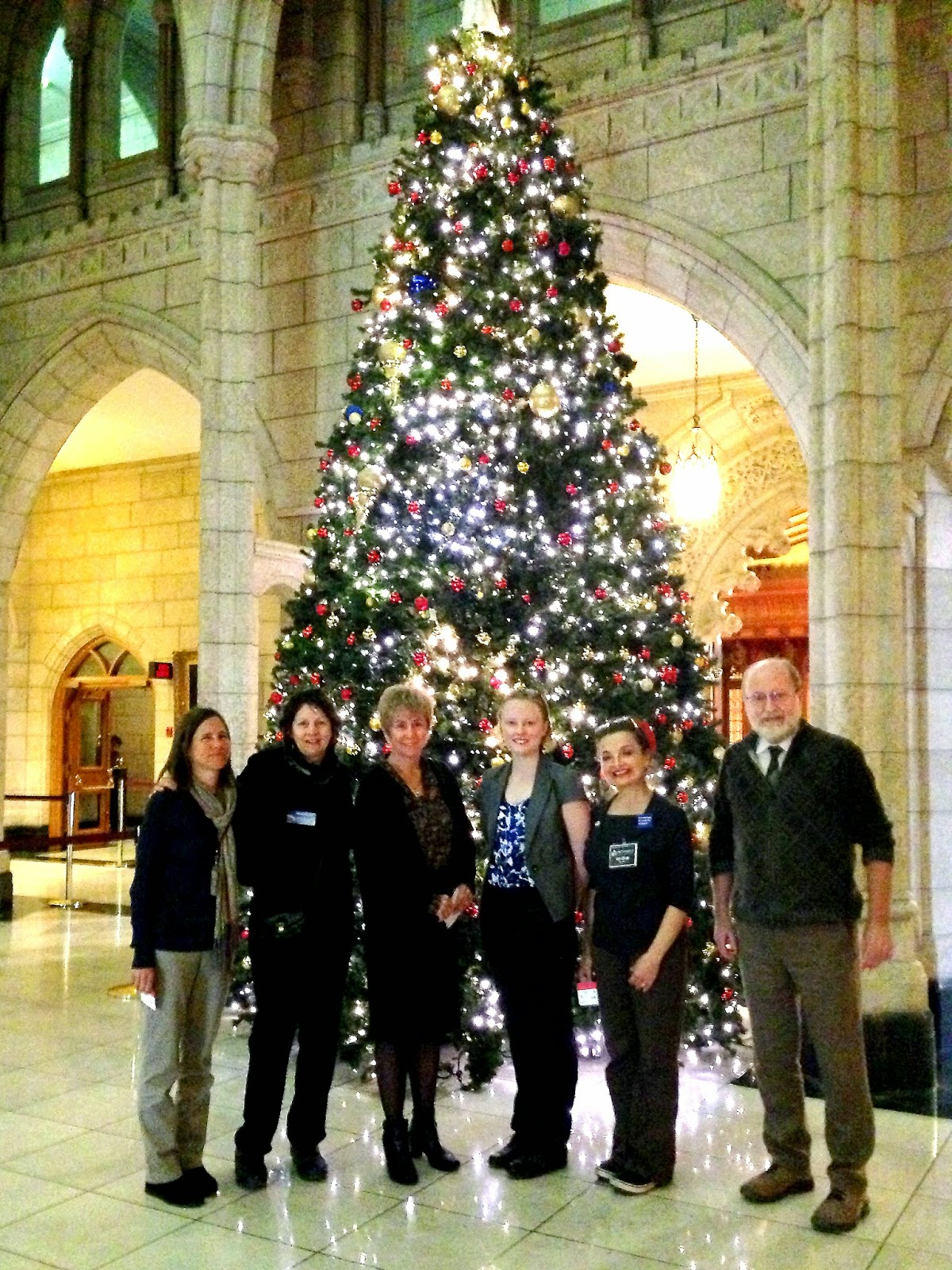
Sen. Nancy Greene Raine (third from left).
The meeting was to have been for a half-hour but the senator was detained and it only lasted for 15 minutes.
The former world ski champion was apologetic for the inconvenience but a fair amount of information was exchanged nevertheless.
Greene Raine was skeptical about some aspects regarding human-caused global warming.
She showed some interest, though, in the dividend side of the fee-and-dividend proposal, which would help those on limited incomes and stimulate the economy.
Those attending the meeting with me included Laura Sacks of Nelson, Rachael Derbyshire of Guelph, Cathy Lacroix of Toronto and Valerie Blab of Red Lake, Ontario.


Sunday, November 30, 2014

Here's a photo of me somewhere in the Prairies, probably Saskatchewan, during my walk in 1987.

Sunday, November 23, 2014

CCL-Canada conference - Day Two

Photo shows the participants in Citizen Climate Lobby 2014 conference - except for the photographer.
The second day of the Citizen Climate Lobby - Canada conference was even more interesting that the first.

Speakers included a Skype appearance by Dr. Katharine Hayhoe, a climate scientist and evangelical Christian who was born and grew up in the Toronto area but who now lives in Texas. She talked about the need to shape your climate change message to your audience - for example, evangelical Christians.

Michael MacMillan talked about his book, "Tragedy in the Commons," which is based on interviews

Michael MacMillan
done with 80 former M.P.s about their experiences in politics. Even though many of them had been in senior cabinet positions, they overwhelmingly were unhappy with the high level of party discipline in the Canadian parliament. Several reforms were suggested.

CCL executive director Mark Reynolds gave an address titled, "The Way Forward." When things go wrong, people ask, "What's wrong with me?", "What's wrong with them?" and "What's wrong with it?" he said. A better approach would be to ask, "What are we committed to?"

A common metaphor used to explain how people react to the threat of climate change is the story of putting a frog in a pot of cool water and gradually warming it. The frog supposedly will remain until it cooks. Tom Rand, the
Tom Rand
keynote speaker in the afternoon, talked about his book "Waking the Frog," which examines the psychology of denial.

Final workshop was a panel discussion on economics with Tom Rand, Celine Bak (president of Analytica Advisors), Stewart Elgie (University of Ottawa and member of the new EcoFiscal Commission), Christopher Ragan (chair of the EcoFiscal Commission), and David Robinson (Institute for Northern Ontario Research and Development).
Although Celine Bak emphasized that she is not an economist, the panel members seemed to agree that the consensus of economists was that the best way to tackle climate change would be by pricing carbon dioxide - preferably through a carbon tax.

Stewart Elgie said a carbon tax set at $30 per tonne (the same as B.C.'s) would generate $20 billion per year federally (assuming there are 20 million adults in Canada, that would mean a carbon dividend as proposed by CCL would amount to $1,000 per year per adult).

The day closed with convention participants getting together to plan their meetings tomorrow (Monday) and Tuesday with M.P.s and senators.
Panelists (l-r) Tom Rand, Christopher Ragan, Stewart Elgie, David Robinson and Celine Bak.

Saturday, November 22, 2014

CCL-Canada conference - Day One

The first day of the Citizens Climate Lobby - Canada 2014 conference in Ottawa was interesting and informative.


Main speaker was Mark Reynolds, the executive director of CCL. He outlined the history of the
organization and outlined the approach they take when speaking with legislators - respectful and non-confrontational, to listen as much as to speak.

Final item on the agenda was the handing out of assignments. I'm to meet with my M.P., Cathy McLeod plus M.P. Nathan Cullen on Monday, and with Senator Nancy Greene Raine on Tuesday. Groups of between three  and five CCLers will be visiting each.

Meeting with the One World Conspiracy

Thursday I added another eight km east of Toronto to my Gandhi Worldwalk. Friday I took took the train to Ottawa, signed in at the Ottawa jail hostel, then met the One World Conspiracy for a beer.

The Conspiracy, for those who don't know, is a guy named Fergus Watt. Some might be surprised to
learn that the Conspiracy consists of one guy sitting in Ottawa with a typewriter (OK, now a computer). Fergus is the executive-director of World Federalist Movement - Canada. He and I worked together back in 1989 when I was trying to use my walk to promote a petition calling for reform of the United Nations. He's quite a smart guy and I respect him a lot.

Fergus reminded me of the Hague Declaration on the Environment that was negotiated in 1989. Back then, there was a worldwide consensus on climate change, that the atmosphere was a global commons, and that there needed to be decisive action. That was before the opposition got organized and things went sideways.

Thursday, November 20, 2014

Gandhi Worldwalk Part 3a

Gandhi Worldwalk is not dead - it's just been delayed.

Starting out from the Guildwood GO station.

Until today (Nov. 20, 2014) the walk consisted of two parts: in 1987 I walked from my home in Clearwater, BC to the north shore of Lake Superior; and in 1989 I walked from where I had left off in 1987 to Toronto.

Today I walked from where I left off in 1989 – the Guildwood GO light rail station just east of Toronto – to the next GO station at Rouge Hill. The distance was only about eight km and, with detours and photo stops, took just under two hours. 


The walk ended in 1989 when I developed plantar fasciitis in my left foot - a tear in the ligament that runs under my arch. The foot still bothers me and I usually wear a night splint (if I don't, after about a week my foot feels as if it's ready to fall apart).


I do a fair amount of walking around Clearwater but it's nearly always on trails - walking on pavement bothers my foot. Today's walk was almost all on pavement and, by the end, I could feel that I had done enough for one day.

One thing I learned on the walk was the importance of giving yourself time to heal if injured or sick. Resting is part of the journey too and, if you don't give yourself enough time to recover, you will accomplish less in the end.

I knew when my walk ended in 1989 that I would return and do some more. Today I did just that. I feel a tremendous sense of accomplishment, even though the distance covered today was trivial. To me, it's the coming back and trying again that is important.

Tomorrow I will take the train to Ottawa to participate in a weekend conference being put on by the Canadian branch of Citizen Climate Lobby. About 70 people have signed up. After some orientation we will fan out and speak to as many M.P.s and senators as will listen about the importance of implementing a carbon fee-and-dividend system as a first step towards controlling global warming.

It's all part of the same journey.
Finishing up at the Rouge Hill GO station.

Sunday, October 12, 2014

This video by an American politician is worth watching. It's basically about Hansen's fee-and-dividend proposal, but he uses the term "carbon rebate" rather than "carbon tax" - focussing on the dividend side of the proposal. His comparison of the rebate cheque with the deniers' lump of coal is particularly effective. A fee-and-dividend system would have to be global to have much effect, but national systems would be a good place to start

https://www.youtube.com/watch?v=U-ESU3srToo

Monday, February 17, 2014

Global carbon tax petition breaks 100

My global carbon tax petition finally broke 100 yesterday, with 10 new names. Five of them are from Belgium, one from Netherlands, and so I think they're connected. The first to sign today was a Mrs. Christina Lambrecht from Belgium. She seems to be an expert on Basic Income, which means this idea would appeal to her.

A few days ago I put a comment about my petition on a posting on the Basic Income News website. Soon after that a Dr. Karl Widerquist signed. He also seems to be a Basic Income expert. So maybe things are starting to snowball a bit.

The petition is at www.thepetitionsite.com/286/384/042/petition-for-a-referendum-on-a-global-carbon-tax/

Friday, January 24, 2014

At Louis Enfield's cabin, Vavenby, BC – Walk 1987

 Here I am on the first day of my walk in the spring of 1987. Although you can't see it, I'm standing in front of a cabin on Moilliets' sheep ranch near Vavenby, B.C. (the structure you can see is a corner of the woodshed). I lived in the cabin for several years in the late 1970s. It was built by Swiss fellow named Louis Enfield, who I never met.

Tuesday, January 21, 2014

Thistle emerging through pavement


As I recall, I took this photo near Borden Bridge in Saskatchewan during my walk in 1987. To me, it carries meaning regarding the power of life to overcome obstacles
Here's a comment I just posted on Care2 in response to an article about the Trans-Pacific Partnership:
 

The Trans-Pacific Partnership appears to be another example of globalization being done for the benefit of the 1% and only incidentally for the rest of us. We - meaning the people of the world - need to get more control over our international institutions. That means more democracy - direct democracy on an international scale.

Climate scientist James Hansen has proposed a global carbon tax with the proceeds to be distributed to everybody (he calls it fee-and-dividend). I have posted a petition on Care2 that calls for a worldwide referendum on a global carbon tax based on Hansen's proposal.

You can view the petition (and hopefully put your name on it) at www.thepetitionsite.com/286/384/042/petition-for-a-referendum-on-a-global-carbon-tax/www.thepetitionsite.com/286/384/042/petition-for-a-referendum-on-a-global-carbon-tax/

Sunday, January 19, 2014

Feasible vs. expedient

We need to be careful when we use the word "feasible" that we don't confuse it with "expedient". The opposition is strongest around the fee-and-dividend approach proposed by James Hansen precisely because it is by far the best approach that would make a meaningful difference in our society's wasteful use of fossil fuels. Fee-and-dividend is the most practical approach, but it will not be easy or convenient.

Once again, I have posted a petition on Care2 that calls for a global carbon tax based on Hansen's fee-and-divident proposal. You can view it (and hopefully put your name on it) at www.thepetitionsite.com/286/384/042/petition-for-a-referendum-on-a-global-carbon-tax/

Thursday, January 16, 2014

Camping out while walking across Manitoba, 1987


Note the bare feet. It seems to me that I put my camera with its timer set on top of my overturned cooking pot to take the photo

Sulphur dioxide safety net wouldn't work

Gwynne Dyer has posted a column talking about how work by researchers at Reading University have shown that trying to control global warming by injecting sulphur dioxide into the atmosphere would lead to a 30 percent decline in rainfall in most of the tropics.

While we might need geo-engineering techniques as stopgap measures, we are extremely unlikely to achieve anything without addressing the root of the problem. Climate scientist James Hansen has called for a global carbon tax with the proceeds to be distributed to all, a proposal he calls fee-and-dividend. I have posted a petition based on his proposal on Care2. You can view the petition (and hopefully put your name on it) at www.thepetitionsite.com/286/384/042/petition-for-a-referendum-on-a-global-carbon-tax/

Thursday, December 26, 2013

Climate change denial and Russian roulette

Here's a comment I just posted in Care2 under the article:

The question of climate change comes down to probabilities and balancing risks versus benefits. My understanding of the IPCC predictions is there is a 2/3 chance that things will get very bad by the end of this century. The far end of the bell curve is a one-in-six chance of conditions becoming catastrophic.

The climate change deniers seem to focus on the near end of the curve, the one-in-six chance that things won't be too bad after all. A gun with one empty chamber and five bullets is not very good odds if you're going to play Russian roulette.

Climate scientist James Hansen has called for a global carbon tax with the proceeds to be distributed to everyone (he calls it fee-and-dividend). I have posted a petition calling for a worldwide referendum on such a global carbon tax on Care2. You can view it and,hopefully, put your name to it, at http://www.thepetitionsite.com/286/384/042/petition-for-a-referendum-on-a-global-carbon-tax/

Tuesday, December 10, 2013

IPCC underestimating extreme climate change

I came across an interesting item recently about Martin Weitzman, a Harvard economist who specializes in the economics of catastrophes, among other things.

According to Weitzman, the IPCC (International Panel on Climate Change) has grossly underestimated the severity of the low probability alternatives in its climate forecasts.

IPCC is predicting that doubling the carbon dioxide in the atmosphere could yield temperature increases of 3.5F (2 C) to 8F (4.5 C) by the end of this century, with a best guess of about 5.5F (3 C). That's with a two-thirds probability – the peak of the bell curve.

That's scarey enough, but when we look at the tails of the bell curve, things get even more disconcerting.

According to Weitzman, there is a five per cent probability of warming greater than 18F (10 C) by the end of this century and a one per cent probability of warming greater than 36F (20 C).
Temperature increases in those ranges would render much of the Earth's surface uninhabitable by human beings.

Climate scientists James Hansen has called for a global carbon tax to control global warming, with the proceeds distributed to everyone as a social dividend or basic income grant.

I have posted a petition on Care2 calling for a worldwide referendum on such a carbon tax. You can view the petition (and hopefully sign it) at http://www.thepetitionsite.com/286/384/042/petition-for-a-referendum-on-a-global-carbon-tax/

Sunday, November 3, 2013


Many have argued that a carbon tax, especially a global carbon tax, would be a good way to help control global warming. But what would be the best way to use the money collected?

Climate scientist James Hansen has suggested there should be a global carbon tax with the proceeds distributed to everyone – in other words, give everyone a social dividend or a basic income grant (BIG).

This is a serious amount of money we're talking about. A global carbon tax similar to British Columbia’s at $30 per tonne of carbon dioxide would generate about $600 billion per year.

Assuming there are 5 billion adults (aged 18 and over) in the world, such a tax would result in a social dividend of about $120 per person per year – effectively doubling the annual income of hundreds of millions of people.
Recently, your editor has been reading “Basic Income Worldwide: Horizons of Reform‚” edited by Matthew C. Murray and Carole Pateman.

One chapter discusses a trial basic income grant (BIG) of N$100 per month (about $10 US or Canadian) given out to all 930 residents under age 60 of Otjivero, a small village in Namibia, in 2008 and 2009.

Namibia has the highest measured income disparity in the world – there are a few who are very wealthy, and a great many who are extremely poor, and Otjivero is one of the poorest villages.

The results of the trial were striking. The unemployment rate dropped from 60 per cent to 40 per cent. Many people started their own businesses as the BIG provided start-up capital and created demand.

Average income per capita went, in one year, from N$118 to N$152. The percentage of malnourished children went from 42 per cent to 17 per cent in six months, and to effectively zero in one year.

The drop-out rate at the school went from 30 to 40 per cent to five per cent within six months and to zero at the end of the first year. Better nutrition for the students meant a turnaround in behavior and performance.

The number of children in pre-school went from 13 to 52.

The overall crime rate went down by 36.5 per cent.

People enlarged their shanties from an average of 2.6 rooms (baseline) to 3.3 after one year. One-fifth indicated they had improved their roofs.

These people were still very poor at the end of the trial, but the data indicates that they were also much better off than they would have been otherwise.

Distributing the money raised by a global carbon tax as a social dividend to all the people of the world would create an enormous market for small-scale, alternative energy technologies. It would be relatively simple to administer and cheating would be difficult.

It would do a great deal to lessen world income disparities. And it would help compensate those whose lives and livelihoods are threatened by the risk of climate change.

I have posted a petition on Care2 that calls for a global carbon tax and a worldwide basic income grant. You can view the petition (and hopefully sign it) at: www.thepetitionsite.com/286/384/042/petition-for-a-referendum-on-a-global-carbon-tax/
 

Tuesday, October 22, 2013

I has just finished reading The Case for a Carbon Tax: Getting Past our Hang-ups to Effective Climate Policy by Shi-Ling Hsu.The author was a professor at the UBC Faculty of Law when he wrote the book. He presently is a professor at Florida State University.

In the book, Dr. Hsu compares four different mechanisms to reduce the amount of carbon dioxide our civilization is putting into the atmosphere and concludes that a carbon tax is best.

Command and control means setting some maximum amount of pollution that a factory or some other polluter can produce. Any amount above that maximum is penalized. These maximums are generally somewhat arbitrarily based on the abatement technology available at the time. Once in place there is no incentive reduce emissions below the maximum. Compliance involves constant monitoring and litigation.

Although there are variations, cap and trade is in some ways similar to command and control in that maximum amounts of pollution are set for each polluter. Those that produce less than their maximum can then trade that amount to polluters who are above their maximum.
Theoretically, cap and trade works well. In reality, however, experience has shown that it's too easy to cheat. Hsu gives as an example refrigerant plants in China that make more money through carbon credits than they do from the actual product they sell.
The Kyoto Protocol is based largely on cap and trade, which is one reason why it has not been working.

Government subsidies are a third option. One problem with this approach is it requires politicians and bureaucrats to pick winners and losers, rather than the marketplace. Government is better at reducing “bads” than it is at increasing “goods”, Hsu observes.

The fourth mechanism, a carbon tax, is simple to implement because fossil fuels – coal, natural gas and oil – are easy to track and measure. Implementing a carbon tax on gasoline in British Columbia, for example, was a trivial problem because federal and provincial taxes were already collected at the fuel pump.

A carbon tax directly rewards and punishes the behaviours we want to encourage and discourage – if you are frugal with fossil fuels you pay less, if you are wasteful, you pay more.
The biggest problem with implementing a carbon tax seems to be that it is a tax, Hsu says, and no one wants to pay another tax.
Another criticism has been that it is regressive – that it taxes the poor more heavily than the rich. Real-life studies have found this is not the case, says Hsu. The very poor, those living on the streets, use little or no fossil fuels directly. They also have alternatives they can use. The very wealthy, on the other hand, have multiple vehicles, yachts, several homes around the world, and private jets. Many of the very wealthy have investments in fossil fuel companies, and so would pay carbon taxes that way.

I put a petition calling for a global carbon tax on Care2 in July. Recently, Roz Savage, a woman who rowed across the Atlantic and Pacific oceans to call for an end to global warming, put her name on it (she doesn't appear to be afraid of anything). If you want to check it out, the address is www.thepetitionsite.com/286/384/042/petition-for-a-referendum-on-a-global-carbon-tax/ .